
Strips · light colour
Light colour: colour temperature, CRI and colour strips
The same strip can feel cosy or completely sterile. What matters is the colour temperature in kelvins and the CRI colour rendering.
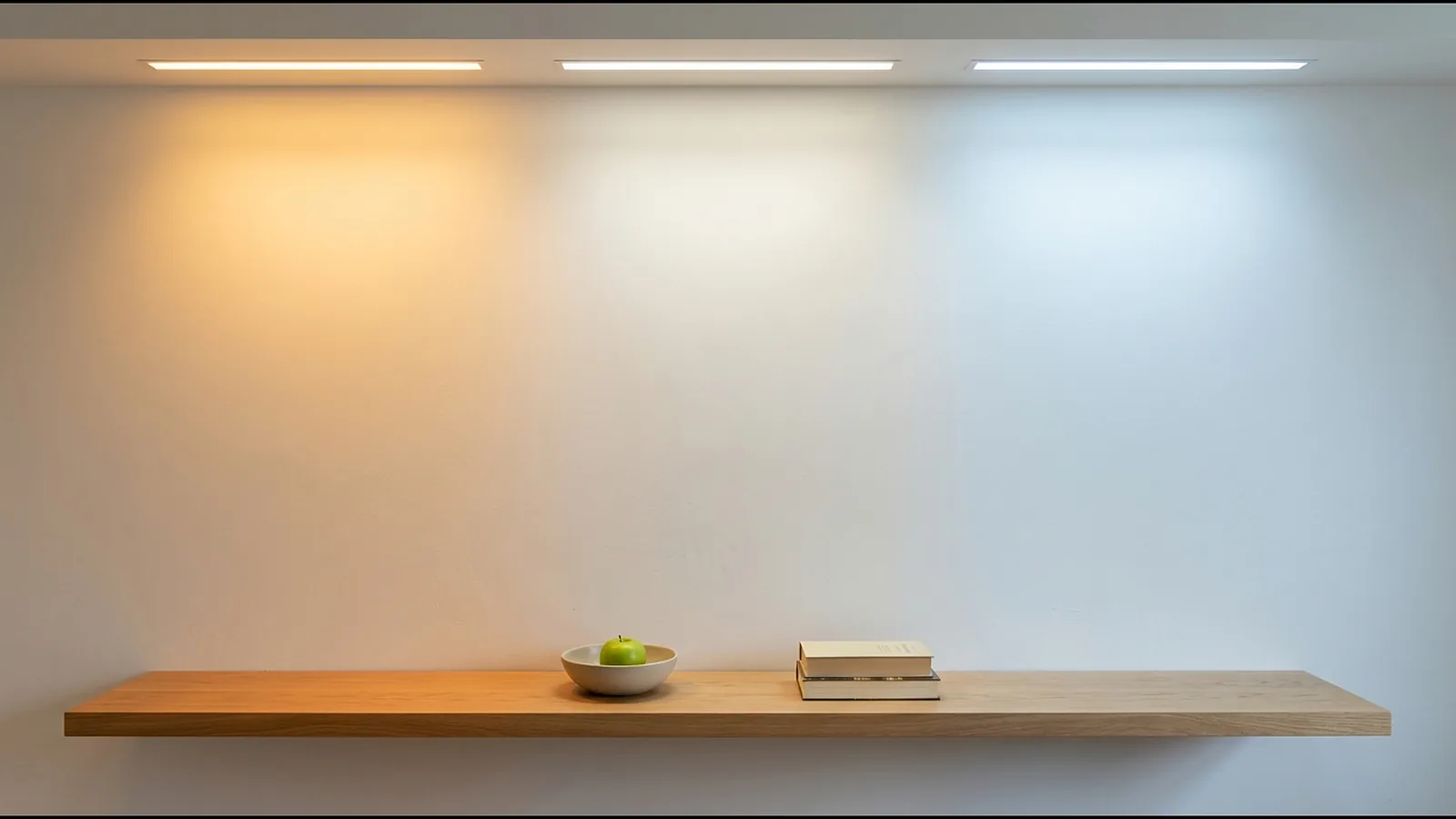
Short answer: for living rooms, choose warm white 3000 K; for the kitchen worktop, neutral 4000 K; and for a workshop or display cabinet, cool 6000 K. If you cannot decide, 4000 K is a universal choice, or a CCT strip, where you set the shade of white with a controller. Colour rendering quality also matters: look for an Ra (CRI) value of at least 80 in the specifications.
What is colour temperature
The colour of white light is given in kelvins (K). A lower number means warmer, yellowish light similar to an incandescent bulb; a higher number means cooler, bluish light similar to an overcast sky. It has nothing to do with the temperature of the light itself; a 6000 K strip does not get hotter than a 3000 K strip.
| Temperature | Designation | Effect | Where it suits |
|---|---|---|---|
| 2700 K | very warm white | like a classic incandescent bulb, very cosy | bedroom, living room, indirect lighting |
| 3000 K | warm white | cosy, pleasant in the evening | living room, dining room, hallway, stairs |
| 4000 K | neutral (daylight) white | clean, for working, no distortion | kitchen, bathroom, office, walk-in wardrobe |
| 5000–6500 K | cool white | crisp, energising | workshop, garage, storeroom, display cabinets |
The e-shop offers single-colour strips in 3000 K (warm white), 4000 K (neutral white) and 6000 K (cool white), for example the series 12.8 W/m warm white, neutral white and cool white.
What suits where in practice
- Kitchen: for the worktop 4000 K; food looks natural. If you want the kitchen to match a warm living room, choose 3000 K. More in the article LED lighting for kitchen units.
- Living room and bedroom: 3000 K, ideally with dimming.
- Stairs and hallway: 3000 K, will not dazzle at night.
- Bathroom: 4000 K at the mirror, 3000 K for indirect lighting.
- Workshop, garage, storeroom: 6000 K and plenty of lumens.
Beware of mixing: do not combine different white temperatures in a single view. Under-cabinet lighting at 4000 K next to ceiling lights at 2700 K looks blue, and the ceiling lights next to it look orange.
CRI (Ra): how faithfully colours appear
The colour rendering index CRI, labelled Ra in Europe, indicates how naturally the colours of objects appear under a given light. The maximum is 100 (daylight, a classic incandescent bulb). For living spaces and indoor work, at least Ra 80 is recommended. Under light with a low Ra, meat looks grey, wood lifeless and skin unhealthy.
The 13.5 W/m strips in the e-shop are specified as Ra 80, for example strip 24 V 3000 K or strip 12 V 4000 K. Always look for the CRI value in the strip specifications.
RGB, RGBW and CCT: when you want to change the colour
| Strip type | What it can do | What it is good for |
|---|---|---|
| Single-colour | one fixed white (3000, 4000 or 6000 K), dimming | most installations |
| CCT | warm and cool white LEDs; you can adjust the shade of white smoothly | living room, kitchen open to the living room |
| RGB | any colour by mixing red, green and blue | decoration, effects, gaming corner |
| RGBW | colours plus a separate white | decoration and everyday lighting with one strip |
| RGB+CCT | colours plus adjustable white | the most versatile solution |
CCT and RGB+CCT strips are not currently in the e-shop; we will be happy to get them for you to order. The closest option in our range is an RGBW strip with colours and a separate white.
White mixed from RGB never looks like pure white; it tends to be bluish or pinkish. If you want to use the strip mainly for lighting and only occasionally for colours, choose RGBW. For strips RGBW 4-in-1 the white chip is integrated into the same LED as RGB, so every LED shines in both white and colours and the line is continuous.
Colour and CCT strips need a suitable controller and receiver, typically Mi-Light (MiBoxer). How to do it is described in the article Controlling and dimming LED strips.
Dimming and light colour
A classic incandescent bulb turns warmer, towards orange, when dimmed. A single-colour LED strip does not change colour when dimmed; it just shines less. If you want to dim the light and make it warmer at the same time in the evening, you need a CCT strip and a controller on which you can shift the shade towards warm white. For stairs and night light, warm white 3000 K and a weaker strip are therefore sufficient.
Choose the colour with three questions
- Will I be working under the light? Yes: 4000 K. No, it is about atmosphere: 3000 K.
- What colour are the other lights in the room? Stick to the same temperature so the shades do not clash.
- Do I want to change the shade according to the time of day or mood? Yes: a CCT or RGB+CCT strip with a controller.
A practical example: an open-plan kitchen and living room, the ceiling lights are 3000 K. Under the cabinets you fit a 3000 K strip so that the kitchen matches the living room, and you choose the more powerful 12.8 W/m version so that there is enough light on the worktop. If you want neutral light for cooking and a cosy light in the evening, go for a CCT strip (supplied to order) or an RGBW strip, which has a separate white.
Summary
First, be clear about what the light is for: task light 4000 K, cosy 3000 K, technical 6000 K. Then make sure Ra is at least 80, and only then consider whether you need colours. The whole set, including the light colour, can be put together for you by selection guide.
For professionals
Technical information for electricians, installers, joiners and architects.
Correlated colour temperature (CCT)
The value in kelvins is the correlated colour temperature: the temperature of a black body whose colour is closest to the colour of the source. White LEDs are made from a blue chip and phosphor; warmer shades need more phosphor, so at the same power they have a lower luminous efficacy (for the 12.8 W/m strips in the e-shop: 1,280 lm/m for warm white versus 1,340 lm/m for neutral and cool).
Colour rendering index
The general colour rendering index Ra (CRI) is calculated as the average of eight test colours R1–R8 according to CIE 13.3. It does not include saturated red R9, which is important for meat, wood and skin; for demanding applications R9 is therefore stated separately. ČSN EN 12464-1 requires Ra ≥ 80 for most indoor workplaces, and higher for demanding visual tasks.
Binning and uniformity
LEDs are sorted into groups (bins) by colour. For long lines made from several reels, order the full quantity at once so that the strips come from the same production batch and the shade does not differ. Colour deviation is described using MacAdam ellipses (SDCM); a smaller number means a smaller visible difference.
Controller channels
Single-colour strip = 1 channel, CCT = 2 channels (warm and cool), RGB = 3, RGBW = 4, RGB+CCT = 5 channels. The receiver must match the number of channels, and its maximum current is divided between the channels.
Frequently asked questions
What light colour should I choose for the kitchen?
For the worktop, most often neutral white 4000 K; food looks natural. If you want the kitchen to match a warm living room, choose 3000 K.
Does cool white shine more than warm white?
Slightly, yes, at the same power, because warmer shades are less efficient. For the 12.8 W/m strips in the e-shop, it is 1,280 lm/m for warm white versus 1,340 lm/m for neutral white.
What does Ra 80 mean?
Colour rendering index 80 out of 100. This is the recommended minimum for living and working spaces; the colours of objects look natural.
Is an RGB or an RGBW strip better?
If you will also use the strip for everyday lighting, choose RGBW. It has a separate white, which is purer than white mixed from RGB.
Build lighting made to measure
The guide puts together the profile, strip, power supply and control from e-shop products. We can also advise by phone +420 777 500 070.
Related articles
 Strips
How to choose an LED strip: chips, LED density and output
Choosing the right LED strip is key to efficient and reliable lighting. What matters is chip density, LED type, output and IP rating.7 min read Control
ling and dimming LED strips
You can switch the strip on with an ordinary switch, dim it with a remote control, control it from your phone or divide it into zones. We will show you what you need for what.7 min read Inspiration
