
Controls · dimming and zones
Controlling and dimming LED strips
You can switch the strip on with an ordinary switch, dim it with a remote control, control it from your phone or divide it into zones. We will show you what you need for what.
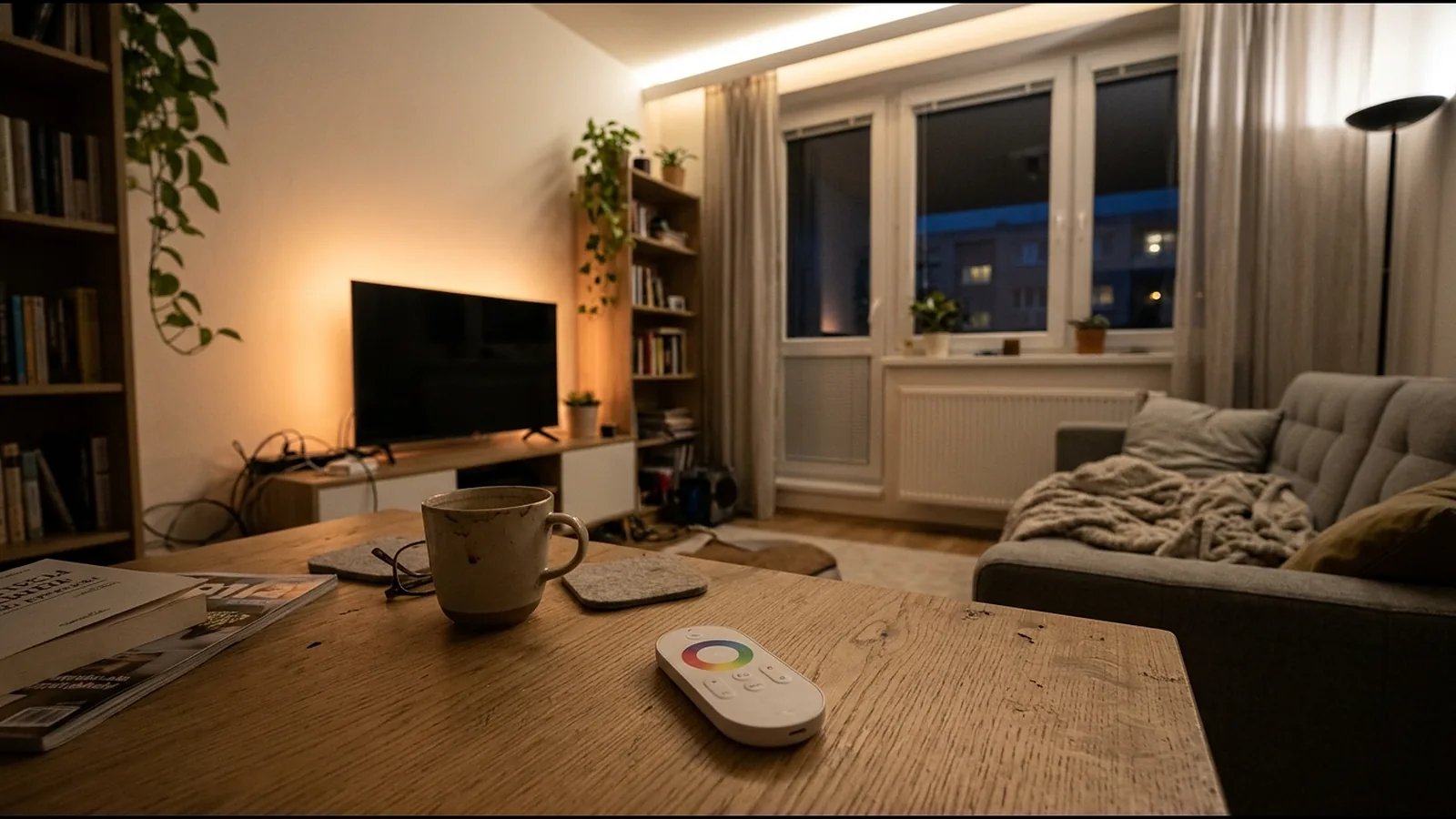
Short answer: only want to switch on and off? A 230 V switch before the power supply is enough. Want to dim? Put a receiver between the power supply and the strip Mi-Light (MiBoxer) and choose a remote or wall controller to go with it. Want to control it from your phone? Add a Wi-Fi module.
How the set is wired
The same order applies to all options: 230 V mains → (switch) → power supply → (receiver or dimmer) → strip. The receiver thus works at a safe voltage of 12 V or 24 V and the remote communicates with it wirelessly.
Option 1: wall switch
An electrician wires the power supply behind an ordinary 230 V switch. You need nothing else; the strip is either at full brightness or off. It is the cheapest and most reliable solution, for example for a wardrobe or utility room.
Option 2: a simple dimmer
LED mini dimmer 1 × 6 A is a wired dimmer connected between the power supply and a single-colour strip. Suitable for smaller sets, for example display cabinet lighting. For RGB strips there is LED mini RGB controller 3 × 2 A.
Option 3: Mi-Light receiver and remote
The most common and most convenient solution. The receiver (control unit) is connected between the power supply and the strip and paired with the remote. You choose the receiver according to the type of strip:
| Strip type | Receiver | Remote (example) |
|---|---|---|
| single-colour | FUT036 | FUT087 (dimming), FUT B1 wall-mounted, battery-powered |
| single-colour and CCT | FUT035S+ (2-in-1) | FUT006 for 4 zones, ML C1 |
| RGB, RGBW, RGB+CCT | FUT037S+ (3-in-1) | FUT096 for 4 zones, FUT B3 wall-mounted |
| RGB+CCT | FUT039 | FUT092 for 4 zones, ML089 for 8 zones |
Mi-Light remotes communicate with receivers at 2.4 GHz over a distance of up to 30 m. The FUT B series wall controllers run on AAA batteries, so you can stick or screw them anywhere without cutting channels. FUT T1 is, by contrast, a wall controller powered by 230 V.
If you want everything in one box, choose a ready-made remote and receiver set, for example RF Touch profi for single-colour strips, for CCT strips or for RGBW strips.
Zones: several lights, one remote
A four-zone remote can control up to 4 lighting circuits independently. Each zone has its own on button. Typically: zone 1 the run under the cabinets, zone 2 the suspended ceiling, zone 3 the shelves, zone 4 the stairs. Each circuit (each power supply) has its own receiver.
You can pair several receivers to one zone. If you feed a long run from two power supplies, each power supply gets its own receiver; you pair both with the same zone and the run then behaves as one light.
How the receiver is paired
- Disconnect the receiver from the power and reconnect it (just switch the power supply off and on).
- Within 3 seconds, briefly press the on button of the chosen zone on the remote.
- If everything went well, the strip will flash several times.
Option 4: control from your phone via Wi-Fi
WL-BOX1 Wi-Fi module connects to your home network and controls Mi-Light receivers. You then dim and switch the strips from a phone or tablet running Android or iOS. The conventional switch keeps working as well.
What to watch out for
- Switch and remote control. If the switch disconnects the power supply from the mains, the receiver gets no power and the remote will not respond. With remote control, keep the power supply permanently live; the switch then serves only as a main switch.
- Metal cabinets block the signal. Do not put the receiver in a closed metal box.
- A 230 V triac dimmer is not for strips. Mi-Light TRI-C1 dims 230 V LED lighting. It does not belong before a standard LED strip power supply; the strip is dimmed on the 12 V side by a receiver.
Safety: connecting the power supply to the 230 V mains may only be done by a person qualified in electrical engineering under Decree No. 250/2021 Coll. (Czech regulation on qualifications in electrical engineering). The 12 V or 24 V side after the power supply is safety extra-low voltage, so you can connect the strip, receiver and controller yourself.
Which option to choose
| Situation | Recommended controls |
|---|---|
| wardrobe, utility room, just on and off | 230 V switch before the power supply |
| display cabinet, small shelf | LED mini dimmer |
| kitchen, living room, retrofit without cutting channels | Mi-Light receiver and battery-powered wall controller |
| several lights in one room | four-zone remote, a receiver for each circuit |
| colour or CCT strips | a receiver for the given strip type and a matching remote |
| control from your phone | receiver, remote and Wi-Fi module WL-BOX1 |
A practical example
Kitchen units 2.4 m with a 12.8 W/m strip: RS-50 W power supply in a cabinet, followed by a FUT036 receiver, and a FUT B1 controller stuck on the wall. An electrician connects the power supply to 230 V; you wire the rest yourself. If shelf or ceiling lighting is added later, you add another receiver and pair it with a different zone of the same remote. The set can also be put together for you by selection guide.
For professionals
Technical information for electricians, installers, joiners and architects.
How dimming works
The receivers dim the strips by pulse-width modulation (PWM) on the low-voltage side: the output is switched rapidly and the brightness is determined by the on-time ratio. The constant-voltage power supply meanwhile works unchanged. The colour temperature of a single-colour strip does not change when dimmed.
Receiver load capacity
The FUT036, FUT035S+ and FUT037S+ receivers have a rated supply of 12–24 V and a maximum current of 12 A. This corresponds to roughly 144 W at 12 V and 288 W at 24 V. With multi-channel receivers the current is shared between the channels, so check the current per channel in the instructions and allow a reserve, as with the power supply. If the circuit is larger, split it between several power supplies with their own receivers paired to the same zone.
Number of channels
Single-colour strip 1 channel, CCT 2 channels, RGB 3, RGBW 4, RGB+CCT 5. The 2in1 receiver handles single-colour and CCT strips; the 3in1 receiver handles RGB, RGBW and RGB+CCT.
Radio communication
The system operates in the 2.4 GHz band. The range of up to 30 m applies in open space; reinforced concrete, metal structures and metal cabinets reduce it. Place the receiver away from metal covers, ideally where there are as few obstacles as possible between it and the remote.
Primary-side dimming
Triac (phase-cut) dimming on the 230 V side is only intended for loads for which the manufacturer permits it (dimmable LED drivers and light fittings). Switched-mode power supplies without a dimming input may behave unstably or be damaged under phase-cut control.
Frequently asked questions
Do I need a special power supply for dimming?
Ne. The strip is dimmed on the 12 V side by a receiver or dimmer connected between the power supply and the strip. The power supply remains a standard one.
How many strips can I control with one remote?
A four-zone remote controls up to 4 circuits independently, the ML089 remote up to 8 zones. You can pair several receivers to each zone.
Can I control the strips from my phone?
Yes, with the WL-BOX1 Wi-Fi module, which controls Mi-Light receivers over your home network from a phone or tablet.
Why does the remote not respond after switching off at the switch?
The switch disconnected the power supply, so the receiver has no power. With remote control, leave the power supply permanently live.
Who wires the switch and the power supply?
Connection to 230 V may only be made by a person qualified in electrical engineering under Decree No. 250/2021 Coll. (Czech regulation on qualifications in electrical engineering). You can connect the 12 V receiver and strip yourself.
Build lighting made to measure
The guide puts together the profile, strip, power supply and control from e-shop products. We can also advise by phone +420 777 500 070.
Related articles
 Power supplies
How to choose a power supply for an LED strip
The power supply is the heart of the whole installation. If it is too weak, it overheats and the strip flickers. And anyone can work it out in a minute.7 min read Strips
Light colour: colour temperature, CRI and colour strips
The same strip can feel cosy or completely sterile. What matters is the colour temperature in kelvins and the CRI colour rendering.6 min read Inspiration
