
Strips · chips and specifications
How to choose an LED strip: chips, LED density and output
Choosing the right LED strip is key to efficient and reliable lighting. What matters is chip density, LED type, output and IP rating.
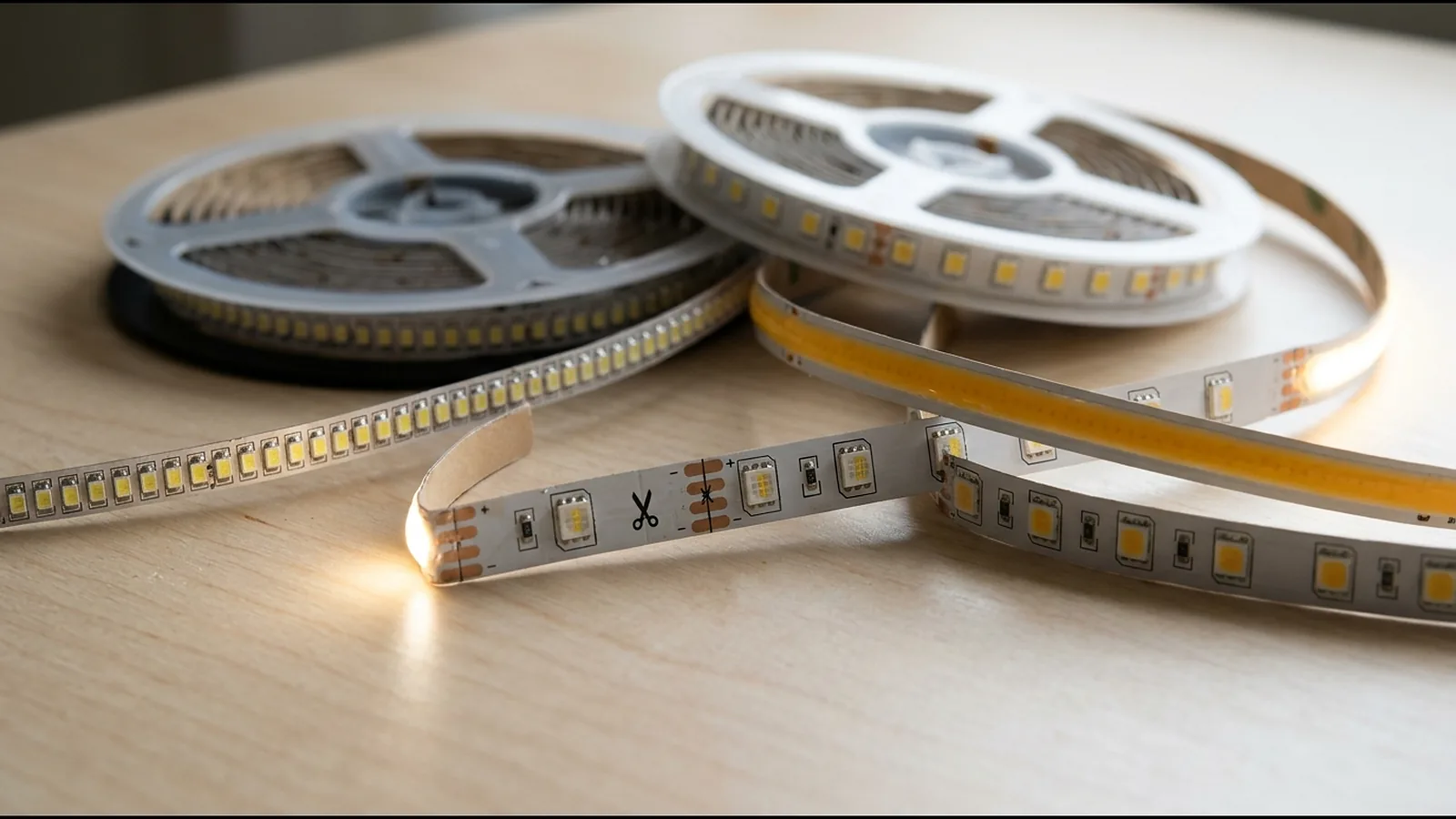
Short answer: for ordinary white light in a flat, choose an SMD 2835 strip with 120 or 144 LEDs per metre. For decoration and furniture, 4.8 W/m is enough; for task lighting in the kitchen, 12.8 W/m; the most light comes from 13.5 W/m. RGB and RGBW colour strips use SMD 5050 chips.
Three things matter: chip density, LED type (SMD 2835 vs 5050) and resistance to dust and water (IP rating). Add the output and the light colour to these.
A clear comparison table of LED strips
| Power (W/m) | Chip density (pcs/m) | Luminous efficacy | Recommended use |
|---|---|---|---|
| 4.8 W/m | 60 | 110 lm/W (approx. 528 lm/m) | Indoor lighting, furniture LED strips, screen backlighting |
| 9.6 W/m | 120 | 110 lm/W (approx. 1,056 lm/m) | Indoor lighting with higher luminous intensity |
| 12.8 W/m | 120 | 110 lm/W (approx. 1,408 lm/m) | Indoor lighting with high luminous intensity |
| 13.5 W/m | 144 (12 V) / 140 (24 V) | 110–140 lm/W (approx. 1,485–1,890 lm/m) | Modern indoor applications, IP20 |
| 18 W/m, 12 V | 60 | 100 lm/W (approx. 1,800 lm/m) | Older SMD 5730, higher luminous intensity, lower efficiency |
The values in the table are an approximate calculation based on efficacy. The exact luminous flux of a specific strip can be found in its specifications, for example strip 4.8 W/m 3000 K has 450 lm/m, strip 12.8 W/m 4000 K 1,340 lm/m and strip 13.5 W/m 3000 K 1,790 lm/m.
Chip density: the key to a continuous line of light
The number of chips per metre determines whether the light is smooth or ‘dotted’ with visible gaps.
- 60 chips/m: lower luminous intensity, suitable for furniture strips and screen backlighting.
- 120 chips/m: a more continuous line, ideal for interior lighting.
- 144 chips/m: the smoothest effect without visible gaps between the chips.
How density relates to the choice of cover is explained in the article Diffuser: milky, opal or clear.
SMD 2835 vs. SMD 5050: modern and specialised technologies
SMD 2835
The most widespread type for single-colour LED strips today. The small size (2.8 × 3.5 mm) allows a high density and smooth lighting; a luminous efficacy of 110–140 lm/W means lower consumption and better heat dissipation. The chip has a metal cooling pad on its underside, which improves heat dissipation. Ideal for interiors, furniture strips and architectural lighting. You will find the full range in the category SMD 2835 LED strips.
SMD 5050
Today it is used mainly for RGB and RGBW strips, where higher luminous intensity per chip is needed and one package contains several colour chips. The larger size (5 × 5 mm) means a lower density and a more pronounced ‘dotted’ effect; it is no longer recommended for single-colour strips.
The older SMD 5730
An outdated type with higher luminous intensity (18 W/m at 12 V), but lower efficiency and poorer heat dissipation. The modern SMD 2835 with a power of 13.5 W/m achieves a higher light output and better cooling, which is why it is the preferred choice today. You will find the older type in the category SMD 5730 LED strips.
COB strips
In COB (chip on board) strips, tiny chips are covered with a continuous layer of phosphor, so they shine as a uniform line even without a diffuser. The e-shop range includes SMD strips; you can get a continuous line with them by combining a dense strip with an opal diffuser.
Power (W/m) and luminous flux (lm/m)
The value in W/m tells you how much the strip consumes per metre. It is used to calculate power supply. How much a strip really shines is given by the luminous flux in lumens per metre (lm/m). Two strips with the same power can shine differently, because the efficacy of the chips (lm/W) matters.
A practical example: a 2.4 m line under the kitchen cabinets with a 12.8 W/m strip consumes 2.4 × 12.8 = 30.7 W and gives out roughly 2.4 × 1,340 = 3,200 lm. For decorative backlighting of a 1 m shelf, a 4.8 W/m strip with 450–480 lm is enough.
IP20 rating: for indoor use
All our SMD 2835 and SMD 5730 LED strips are rated IP20, which is the standard for dry indoor spaces: furniture lighting, suspended ceilings, architectural lighting. IP20 strips do not belong outdoors or in a bathroom, even when they are in a profile. Where the air is more humid or dusty, for example by the sink, use a covered profile with a diffuser and consider a power supply power supply rated IP67, which protects the power supply electronics from moisture. Use in a bathroom or outdoors is a decision for an electrician.
Cutting, packs and installation
- It is cut only at the marked point across the copper pads. The distance between cutting points varies according to the type of strip and is marked on the strip.
- On the back there is 3M self-adhesive tape for easy mounting in the profile.
- The pack is 5 m or 20 m depending on the type of strip.
- 12 V and 24 V strips differ only in voltage. A 24 V strip can handle a longer line without a drop in brightness, see voltage drop on long lines.
Heat dissipation: the importance of anodised aluminium profiles
An anodised aluminium profile has excellent thermal conductivity and ensures fast heat dissipation from the light chips, which extends the life of the strip even with the lower heat generation of SMD 2835 chips. Without sufficient cooling, the LED chips can be damaged. You will find suitable profiles in our LED profiles category and in the article How to choose an aluminium profile.
Conclusion
When choosing an LED strip, consider the chip density (120–144 chips/m for smooth lighting) and the LED type: the modern SMD 2835 offers the best ratio of output to cooling. Choose the light colour according to the article Light colour and CRI. If you have any further questions, our experts will be happy to help you choose the right solution.
For professionals
Technical information for electricians, installers, joiners and architects.
Efficacy and luminous flux
Luminous flux per metre = power per metre × luminous efficacy. For 12.8 W/m and 110 lm/W, the result is 1,408 lm/m; the actual strips in the e-shop have 1,280–1,340 lm/m depending on the colour temperature (warm white has a lower efficacy than cool white because of the phosphor). A 13.5 W/m strip with a flux of 1,820 lm/m has an efficacy of about 135 lm/W.
Current and wiring
Strip current I = P / U. One metre of 13.5 W/m strip draws, at 12 V, about 1.13 A, and at 24 V about 0.56 A. A five-metre reel of 13.5 W/m therefore draws, at 12 V, 5.6 A. 12 V strips have LEDs in series groups with a resistor; a group is the smallest section that can be cut.
IP rating according to ČSN EN 60529
| Code | Protection against solid objects | Protection against water |
|---|---|---|
| IP20 | objects over 12.5 mm (fingers) | none |
| IP44 | objects over 1 mm | splashing water |
| IP65 | dust-tight | water jets |
| IP67 | dust-tight | temporary immersion |
An IP20 strip in a profile with a diffuser remains an IP20 device, unless the profile manufacturer states otherwise (e.g. FLOOR with the cover strip glued in with silicone up to IP67, V-45 up to IP65). In damp areas and bathrooms, according to ČSN 33 2000-7-701, the IP rating and location of the power supply are decided by an electrician.
Safe voltage
12 V and 24 V DC strips powered from a supply with safe isolation fall within the SELV extra-low voltage band (up to 120 V DC according to ČSN 33 2000-4-41). The strip itself is therefore safe to touch, but the 230 V primary side of the power supply is not.
Frequently asked questions
How do I choose the right chip density for continuous lighting?
For smooth light lines, choose a high density of 120–144 chips/m. This prevents visible gaps between the individual chips.
Which is better: SMD 2835 or SMD 5730?
SMD 2835 is the preferred choice today thanks to its higher luminous efficacy (up to 140 lm/W) and better heat dissipation. SMD 5730 is still available, but less efficient.
Do you offer LED strips rated IP67?
We currently offer LED strips rated IP20, intended for dry indoor spaces. So do not use them outdoors or in a bathroom. By the sink or in a dusty environment, a covered profile with a diffuser and a power supply rated IP67, which protects the power supply electronics, will help.
Where can I cut an LED strip?
Only at the marked points across the copper pads. The distance between cutting points varies according to the type of strip.
Is a 12 V or a 24 V strip better?
At the same power, half the current flows through a 24 V strip, so it can handle a longer line without a drop in brightness. For short lines up to about 5 m, the difference is negligible. 24 V power supplies are not in the e-shop yet; we will supply them to order.
Build lighting made to measure
The guide puts together the profile, strip, power supply and control from e-shop products. We can also advise by phone +420 777 500 070.
Related articles
 Strips
Light colour: colour temperature, CRI and colour strips
The same strip can feel cosy or completely sterile. What matters is the colour temperature in kelvins and the CRI colour rendering.6 min read Power supplies
How to choose a power supply for an LED strip
The power supply is the heart of the whole installation. If it is too weak, it overheats and the strip flickers. And anyone can work it out in a minute.7 min read Profiles
