
Profiles · diffusers
Diffuser: milky, opal or clear?
The diffuser determines whether you see a continuous line of light or a row of dots. We explain how to choose the material, shape and depth of the profile.
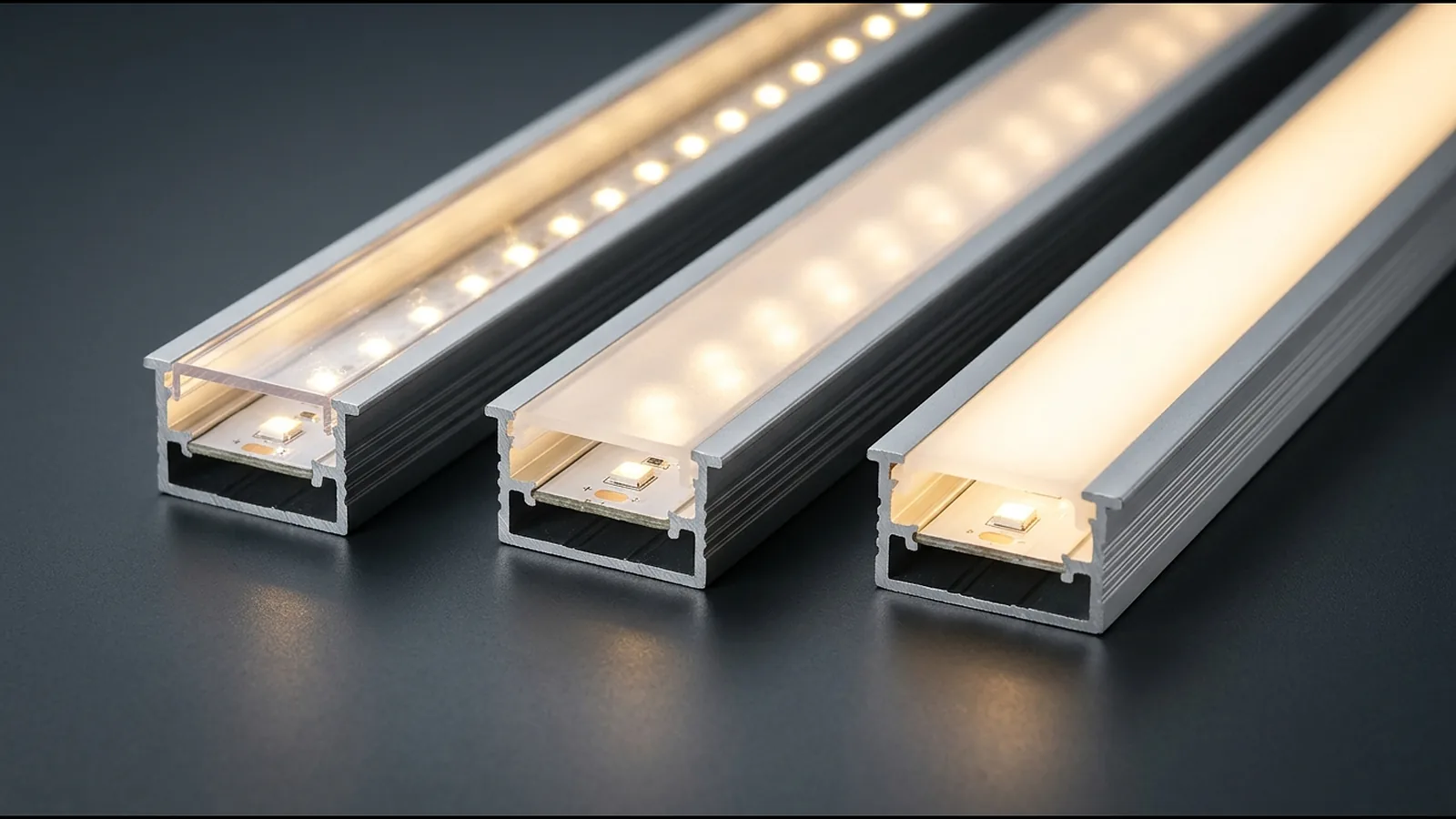
Short answer: living spaces call for an opal diffuser, because it hides the individual LEDs and the light is pleasantly soft. Choose a clear diffuser where you need maximum light and the dots do not matter. A frosted diffuser is a compromise between the two.
What a diffuser does
A diffuser is a cover strip that slides or clips into the aluminium profile. It covers the LED strip itself, protects it from dust and touch, and above all diffuses the light. Without a diffuser, you see each LED as a sharp point that dazzles when viewed up close. A good diffuser creates an even line of light.
Three types of material
| Diffuser | Appearance of the light | Transmittance (approximate) | Where it suits |
|---|---|---|---|
| Milky (opal) | soft, even, LEDs hidden | the lowest of the three | flats, kitchens, bedrooms, suspended ceilings |
| Frosted (frost) | diffused, LEDs faintly noticeable | medium | hallways, offices, furniture |
| Clear (transparent) | sharp, LEDs visible | the highest | display cabinets, exhibition and technical lighting, workshops |
The terms ‘milky’ and ‘opal’ mean the same thing in practice: a white translucent but not transparent material that spreads the light over an area. In the e-shop you will find, for example opal, clear and frosted diffuser (frost) for profiles CORNER 12, HIGH WIDE and MIKRO WIDE.
Why dots are visible and how to get rid of them
The dotted effect occurs when the LEDs are far apart and at the same time close to the diffuser. Three things determine the result:
- LED density on the strip. A strip with 60 LED/m has LEDs roughly 17 mm apart, a strip with 120 LED/m about 8 mm, and one with 144 LED/m just under 7 mm. The denser the strip, the more continuous the line. More details in the article How to choose an LED strip.
- Distance between strip and diffuser. A deeper profile means more room to diffuse the light. Shallow MIKRO UP (height 6 mm) gives noticeable dots with a sparser strip; a deeper HIGH WIDE IN gives softer light.
- Diffuser material. Opal hides more than frosted; clear hides nothing.
A practical example: under the cabinet there is a glossy worktop in which the line is reflected. With a 60 LED/m strip in a shallow profile with a clear cover, you will see a row of light points on the worktop. The same location with a 120 LED/m strip and an opal diffuser gives a continuous band in the reflection.
Diffuser shapes: BOW, TRIANGLE, CUBE, TUBE
Most profiles have a flat diffuser flush with the edge of the profile. Some profiles also offer shaped versions:
- BOW: a rounded (semicircular) cover that protrudes from the profile and spreads the light over a wider angle, e.g. diffuser CORNER 16 BOW opal.
- TRIANGLE: a square cover for a corner profile that closes the profile into a triangle, e.g. CORNER 16 TRIANGLE opal.
- CUBE: a square cover for surface-mounted and suspended profiles, e.g. WALL CUBE or CEILING CUBE.
- TUBE: a rounded cover that forms a round shape together with the profile, e.g. WALL TUBE or CEILING TUBE.
The shape is chosen mainly for appearance. However, the diffuser must belong to the specific profile, because the grooves differ between series. So always check which diffusers are intended for the profile. What helps selection guide, which offers only compatible parts.
Slide-in or clip-on?
For many profiles, the diffuser can be slid in from the end or clipped in from the front. Clipping in is more convenient for long lines and where the end of the profile is not accessible, such as a recessed profile in the corner of a room. Sliding in is more secure where the diffuser gets touched. Diffusers are flexible, sturdy and resistant to heat and UV radiation; one piece is usually at most 2 m long.
Diffuser colour for black profiles
For black anodised profiles there are also black versions of diffusers, for example diffuser CORNER 12 and MIKRO WIDE black or clip-on diffuser for MIKRO UP BLACK and PDS BOX UP BLACK. When switched off, the profile then looks like a solid black line.
How much light is left after the diffuser
Every diffuser absorbs part of the light. So allow a reserve when choosing the strip. Example: a 12.8 W/m strip has 1,340 lm/m. If the diffuser lets through roughly 80%, around 1,070 lm/m comes out of the profile. If you want maximum light on the worktop and do not want to see dots, choose a more powerful strip with an opal diffuser rather than a weaker strip with a clear cover.
Maintenance and replacement
The diffuser can be removed from the profile, so the strip can be checked or replaced later. That is why you should not glue the diffuser. Dust can simply be wiped off with a damp cloth, without solvents, which can cloud the plastic. The FLOOR walk-on profile is an exception: there the cover strip is glued with silicone for a tight seal.
To sum up
- Living spaces: opal diffuser and a strip with 120–144 LED/m.
- Where a lot of light is needed: a frosted diffuser and a more powerful strip.
- Display cabinets and technical lighting: clear diffuser.
- Glossy surfaces under the cabinets: always an opal diffuser, otherwise the dots are reflected.
You will find all covers in the category Diffusers for LED profiles.
For professionals
Technical information for electricians, installers, joiners and architects.
LED spacing and profile depth
The LED spacing is 1000 mm divided by the number of LEDs per metre: 60 LED/m = 16.7 mm, 120 LED/m = 8.3 mm, 140 LED/m = 7.1 mm, 144 LED/m = 6.9 mm. Rule of thumb for an opal diffuser: the dots stop being noticeable when the distance between the strip and the diffuser is at least equal to the LED spacing. A frosted diffuser needs a greater distance; a clear one does not hide the dots at all. This is a rule of thumb; the result depends on the specific material and the beam angle of the LED (for SMD 2835, typically 120°).
Transmittance
Transmittance indicates the proportion of luminous flux that the diffuser lets through. For clear polycarbonate or PMMA it is around 90%; frosted and opal materials let through less, typically in the range of roughly 50–85% depending on thickness and filler. The specific value is given by the manufacturer for each diffuser; for example, the diffuser for BIG CEILING TUBE is stated with a transmittance of 85%. When designing illuminance, work with the luminous flux of the strip multiplied by the transmittance of the diffuser.
Glare and reflections
Point sources with high brightness on a small area increase discomfort from glare. An opal diffuser reduces the surface brightness of the light by spreading the light over a larger area. On glossy worktops the brightness of the line is mirrored, so for kitchens it is a good idea to combine opal, a dense strip and a profile with angled light.
Frequently asked questions
Is an opal diffuser the same as a milky one?
Yes, in practice they are the same thing: a white translucent but not transparent material that diffuses the light and hides the individual LEDs.
Why can I see dots even through the diffuser?
The strip is too sparse or lies too close to the diffuser. A denser strip (120–144 LED/m), a deeper profile, or an opal instead of a frosted or clear diffuser will help.
How much light does a diffuser take away?
A clear diffuser takes away the least, an opal one the most. The exact transmittance depends on the material; for example, the diffuser for BIG CEILING TUBE has a stated transmittance of 85%.
Does every diffuser fit every profile?
Ne. The grooves differ between profile series, so choose a diffuser designed for the specific profile. The selection guide offers only compatible parts.
Build lighting made to measure
The guide puts together the profile, strip, power supply and control from e-shop products. We can also advise by phone +420 777 500 070.
Related articles
 Profiles
How to choose an aluminium profile for LED strips
An aluminium profile is the basis of every professional LED strip installation. It is not just about appearance, but mainly about heat dissipation, which extends the life of the strip.7 min read Strips
How to choose an LED strip: chips, LED density and output
Choosing the right LED strip is key to efficient and reliable lighting. What matters is chip density, LED type, output and IP rating.7 min read Inspiration
