
Profiles · guide to types
How to choose an aluminium profile for LED strips
An aluminium profile is the basis of every professional LED strip installation. It is not just about appearance, but mainly about heat dissipation, which extends the life of the strip.
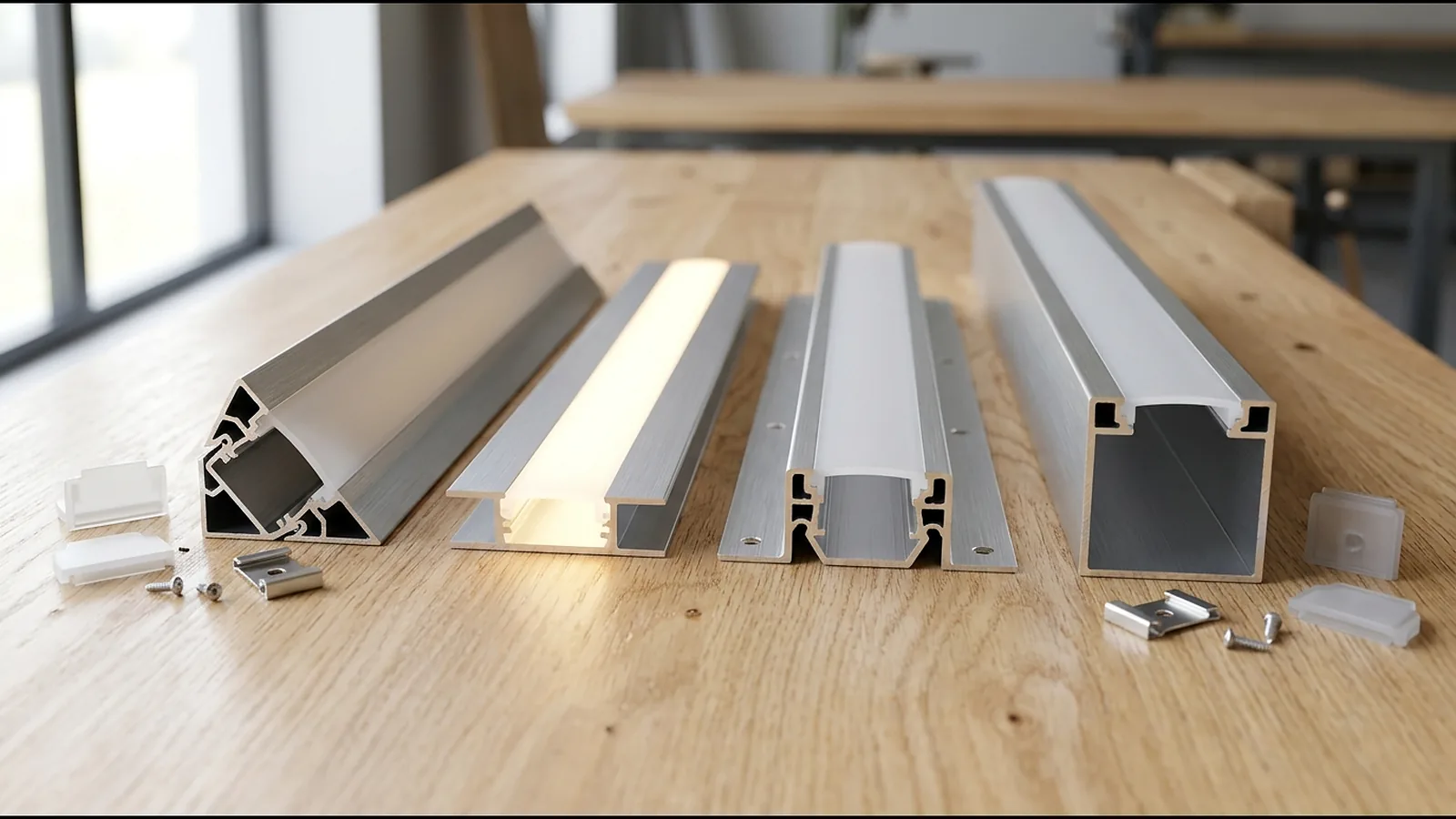
Short answer: a corner profile is usually best for a corner or under a cabinet, a surface-mounted one for a flat surface, a recessed one for furniture or plasterboard, and a suspended one above a table. A walk-on profile belongs in the floor, and a special glass profile on a glass shelf. Add an opal diffuser, end caps and mounting clips to every profile.
Why you need an aluminium profile at all
An LED strip stuck directly onto a surface without a profile heats up faster, which shortens its life and reduces its light output. An anodised aluminium profile works as a passive heat sink: it conducts heat away from the chips, so the strip lasts longer and shines more steadily. The profile also protects the strip mechanically and, in combination with diffuser diffuses the light into an even line without visible individual points.
To give you an idea: chipboard and plasterboard hardly conduct heat away at all; aluminium does. A strip on wood therefore heats up more than the same strip in a profile. The difference shows after hundreds of hours of use, when a strip without cooling loses brightness faster.
Overview of profile types by use
| Profile type | Mounting | Typical use |
|---|---|---|
| Corner | For an inside or outside corner | Wall-to-ceiling transitions, furniture corners, staircases, the bottom edge of cabinets |
| Surface-mounted (wall) | Surface-mounted on a flat surface | Indirect wall lighting, suspended ceilings, shops, shelves |
| Recessed | Set into a groove in furniture or plasterboard | Kitchen units, built-in wardrobes, plasterboard |
| Suspended | On cables from the ceiling | Offices, open-plan spaces, designer lighting |
| Walk-on (FLOOR) | Built into tiles or cladding | Indoor floors and stairs |
| On glass (GLASS 8) | Fitted onto the edge of a glass shelf | Backlighting of glass shelves and display cabinets |
Corner profiles: the most versatile choice
Corner profiles are among the best-selling categories. They handle the transition between two surfaces and are excellent at hiding cabling. The range includes various sizes, for example the compact CORNER 16 (16 × 16 mm) in silver or the black anodised version, or the larger CORNER 12 (18 × 18 mm) for more powerful strips with a higher heat load. For an unobtrusive installation with the maximum beam angle, also suitable is CORNER 30.
When you need to direct the light at an angle, for example from under a kitchen cabinet onto the worktop, the answer is CORNER 60/30°, which, depending on how it is turned during installation, shines at an angle of 60° or 30°. Corner profile V-45 shines at an angle of 45° and, when turned 90° towards the wall, gives pleasant indirect lighting.
Surface-mounted profiles: the quickest installation
A surface-mounted (wall) profile is simply screwed on or clipped into mounting clips on a flat surface. No routing is needed, so it is the simplest way to retrofit into finished furniture. The smallest is MIKRO UP measuring 15 × 6 mm, universal PDS4 BOX UP 16 × 12 mm can be surface-mounted or routed in, and for wide strips up to 20 mm there is WIDE UP.
Recessed profiles: a clean look without a visible strip
If you want only a band of light to be visible without the profile frame, a recessed profile is set directly into a groove in the material while the furniture or plasterboard is being made. It is more demanding to install, but the result is the cleanest possible. An example is MIKRO WIDE IN, also available in a black anodised finish. Recessed profiles have an overlap (flange) on the front that covers any unevenness from routing or cutting. Thanks to its height of 12 mm, a good fit for plasterboard is PDS4 BOX IN, details can be found in the article LED profile for plasterboard.
Suspended profiles: a light above the table
A suspended profile hangs on cables from the ceiling and becomes a linear light, for example above a desk or counter. Typically this is CEILING or the larger BIG CEILING TUBE. The corner CORNER 30 can also be used as a suspended profile; for hanging, use profile suspension hanger.
Walk-on profile and glass profile
FLOOR walk-on profile is built into tiles and cladding. The cover strip is wedge-shaped and is glued, ideally with a good-quality clear silicone adhesive, achieving a rating of up to IP67. You can use it on stairs, see lighting stairs with LED strip. Profile GLASS 8 is designed for backlighting glass shelves 8 mm thick.
Profile colour: silver or black anodised?
Most profiles are sold in two surface finishes:
- Silver anodised: the classic, universal choice; it blends in well with aluminium or white elements of the interior.
- Black anodised: less conspicuous on dark furniture or in modern minimalist interiors, for example PDS4 BOX UP in the black version.
Diffuser: opal or clear?
A diffuser is a cover strip that covers the LED strip itself and diffuses the light. Opal diffuser (e.g. diffuser CORNER 16 BOW opal) gives softer, more even light and hides the individual chips better, so it is suitable for living spaces. Clear diffuser lets through more light, but the chips are often individually visible, which is better suited to technical or exhibition lighting. This is discussed in detail in the article Diffuser: milky, opal or clear.
How to choose a profile in four steps
- Location: corner, flat surface, groove, hanging, floor or glass (see the table above).
- Strip width: the strip must lie across its full width on the bottom of the profile. For example, MIKRO UP takes a strip up to 10 mm, MIKRO WIDE up to 12 mm, WIDE IN and WIDE UP up to 20 mm.
- Strip power: the more watts per metre, the larger the profile you should choose. For a 13.5 W/m strip, CORNER 12 is better than the smallest profiles.
- Accessories: diffuser, end caps (one with a cable hole) and mounting clips.
A practical example: a 2.4 m line under the wall cabinets. You choose a corner profile and cut it to length with a saw. When the length of one piece is limited (2 m for many profiles), you build the line from two pieces butted together and run the strip across the joint in one piece. You need 2 end caps (one with a hole for the supply) and mounting clips roughly every 50 cm, i.e. about 6 pieces. The whole set, including the power supply, can be put together for you by selection guide.
Conclusion
The choice of profile depends mainly on the installation location: corner profiles for transitions between surfaces, surface-mounted (wall) for quick mounting on a flat surface, recessed for the cleanest look in furniture, and suspended for designer office lighting. Always remember to add a suitable diffuser and mounting clips. Our specialists will be happy to help you choose a specific model on +420 777 500 070.
For professionals
Technical information for electricians, installers, joiners and architects.
Heat dissipation
The aluminium alloys used for profiles (typically the 6000 series, e.g. 6063) have a thermal conductivity of around 200 W/(m·K); chipboard and plasterboard are in the order of tenths of a W/(m·K). In the profile, the strip is therefore thermally connected to a surface that spreads the heat along its length and passes it to the surroundings. What matters is that the strip sits fully on the bottom of the profile across its whole surface (adhesive tape without air pockets) and that there is free space around the profile. A recessed profile embedded in insulation or enclosed in a cavity without air circulation cools much less effectively.
The anodised layer is a thin oxide layer of aluminium, hard and electrically non-conductive. It has a negligible effect on heat dissipation; silver and black anodising do not differ thermally.
Recommendations by strip power
| Strip power | Profile |
|---|---|
| up to 4.8 W/m | recommended for appearance and protection; thermally, even small profiles are sufficient |
| 9.6–12.8 W/m | a profile significantly extends the life; standard profiles are suitable |
| 13.5 W/m and more | a profile with a larger cross-section (e.g. CORNER 12, WIDE), not the smallest MIKRO series |
Maximum strip width according to the profile descriptions
| Profile | Max. strip width |
|---|---|
| MIKRO UP, MIKRO IN, PDS4 BOX UP, PDS4 BOX IN, V-45 | 10 mm |
| CORNER 16, CORNER UNI, MIKRO WIDE UP/IN, HIGH WIDE IN | 12 mm |
| PDS4 BOX H, PDS NK BOX IN H | 13.5 mm |
| WIDE IN, WIDE UP | 20 mm |
IP rating and thermal expansion
- According to the manufacturer, the V-45 profile can achieve IP65, and the FLOOR walk-on profile with the cover strip glued in with silicone up to IP67 (ČSN EN 60529). The IP rating of the assembly always depends on carefully sealing the end caps and cable glands.
- The coefficient of thermal expansion of aluminium is about 23 µm/(m·K). A 2 m profile heated by 30 K lengthens by about 1.4 mm. For long lines butted together, leave a minimal gap at the joint and do not glue the diffuser rigidly along its entire length.
Frequently asked questions
Do I always have to install an LED strip in an aluminium profile?
It is not necessary, but for more powerful strips (over 9.6 W/m) a profile significantly extends their life thanks to better heat dissipation, and at the same time protects the strip from mechanical damage.
Which profile should I choose for kitchen units?
For kitchen units, a recessed profile set into the bottom edge of the wall cabinet is most often used, or a surface-mounted or corner profile if you do not want to rout a groove into the furniture.
What is the difference between silver and black anodising?
It is purely an aesthetic choice and a matter of how well the surface resists fingerprints. Functionally (heat dissipation), both versions are identical.
Will my strip fit into the profile?
The maximum strip width is stated for each profile, for example 10 mm for MIKRO UP or 20 mm for WIDE IN. The strip must lie across its full width on the bottom of the profile.
Build lighting made to measure
The guide puts together the profile, strip, power supply and control from e-shop products. We can also advise by phone +420 777 500 070.
Related articles
 Profiles
Diffuser: milky, opal or clear?
The diffuser determines whether you see a continuous line of light or a row of dots. We explain how to choose the material, shape and depth of the profile.6 min read Strips
How to choose an LED strip: chips, LED density and output
Choosing the right LED strip is key to efficient and reliable lighting. What matters is chip density, LED type, output and IP rating.7 min read Mounting
