
Power supplies · calculating output
How to choose a power supply for an LED strip
The power supply is the heart of the whole installation. If it is too weak, it overheats and the strip flickers. And anyone can work it out in a minute.
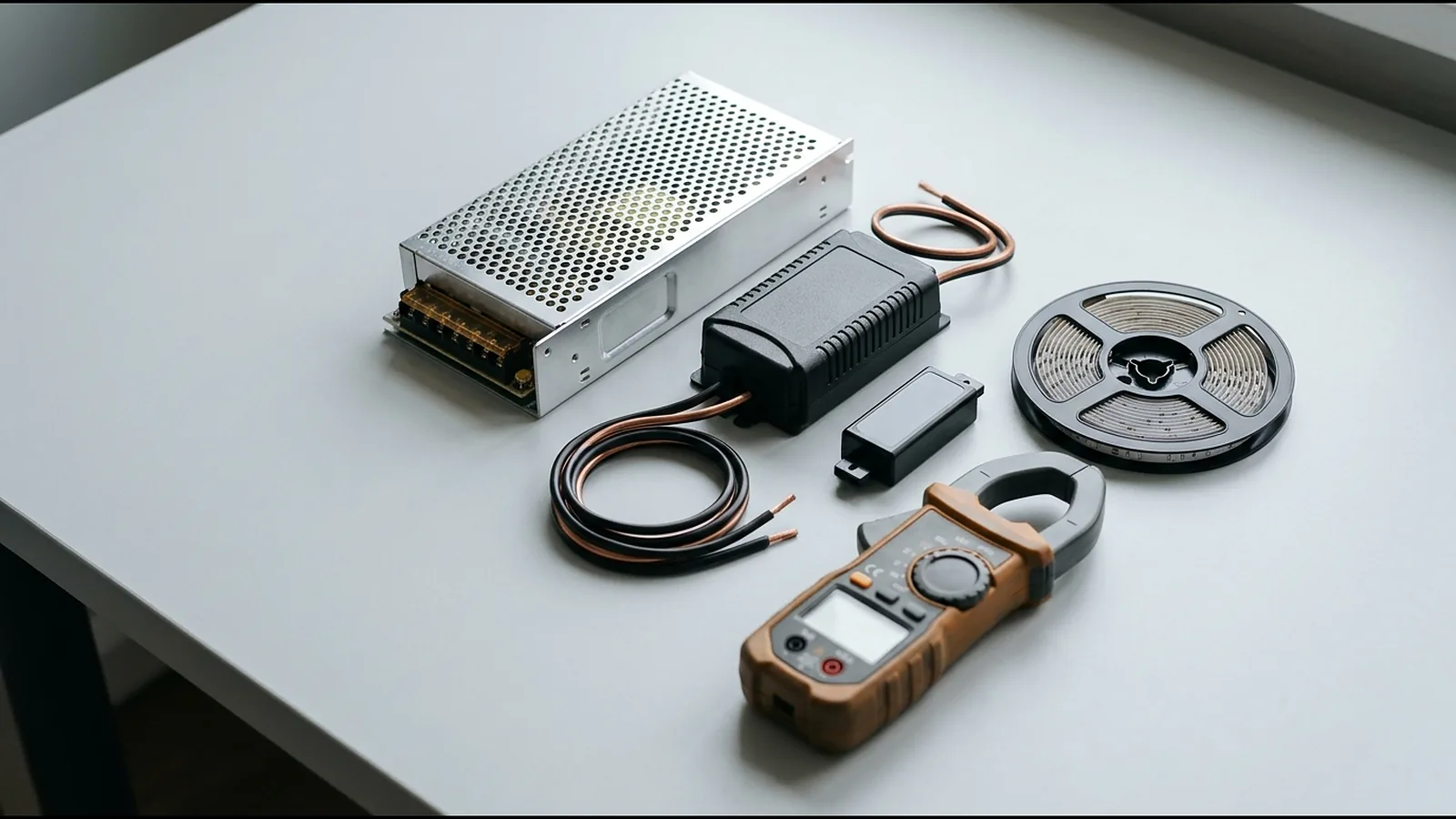
Short answer: multiply the strip length in metres by its power in W/m, add a 20% reserve and choose the nearest higher power supply with the same voltage as the strip. For a dry space, IP20 is enough; for damp areas or outdoors, choose IP67. Place the power supply where it is accessible and can cool.
Calculation in three steps
- Calculate the strip power: length × W/m. You will find the W/m value in the strip specifications.
- Add a 20% reserve: multiply the result by 1.2. The power supply then does not run at its limit, heats up less and lasts longer.
- Choose the nearest higher output power supplies with the same output voltage as the strip.
Example 1, kitchen units 2.4 m: strip 12.8 W/m. 2.4 × 12.8 = 30.7 W, with reserve 30.7 × 1.2 = 36.9 W. A 35 W power supply would run at its limit and is not enough; the right choice is power supply RS-50 W / 12 V.
Example 2, living room suspended ceiling 10 m: strip 9.6 W/m. 10 × 9.6 = 96 W, with reserve 115 W. Suitable: power supply RS-150 W / 12 V. However, do not feed a 10 m line at 12 V from one end, see voltage drop on long lines. It is often more practical to split it into two halves of 5 m, each with its own RS-75 W power supply (5 × 9.6 × 1.2 = 57.6 W).
Example 3, shelf 1 m: strip 4.8 W/m. 4.8 × 1.2 = 5.8 W. The smallest power supply is enough; the reserve here is large.
How much strip each power supply can handle
The table shows the maximum strip length for the 12 V Mean Well power supplies from the e-shop, already including the 20% reserve.
| Power supply | IP rating | 4.8 W/m | 9.6 W/m | 12.8 W/m | 13.5 W/m |
|---|---|---|---|---|---|
| LPV 35 W | IP67 | 6.0 m | 3.0 m | 2.2 m | 2.1 m |
| RS-50 W | IP20 | 8.6 m | 4.3 m | 3.2 m | 3.0 m |
| RS-75 W | IP20 | 13.0 m | 6.5 m | 4.8 m | 4.6 m |
| RS-100 W | IP20 | 17.3 m | 8.6 m | 6.5 m | 6.1 m |
| LPV 100 W | IP67 | 17.3 m | 8.6 m | 6.5 m | 6.1 m |
| RS-150 W | IP20 | 26.0 m | 13.0 m | 9.7 m | 9.2 m |
Lengths over about 5 m mean that the power supply feeds several sections of strip. Connect each section with a separate supply lead, not as one long line in series.
12 V or 24 V?
The power supply voltage must exactly match the strip voltage. A 24 V strip on a 12 V supply shines weakly or not at all; a 12 V strip on a 24 V supply is destroyed within moments. The Mean Well power supplies in the e-shop have a 12 V output; the strips come in both 12 V and 24 V versions, so always check the voltage in the specifications. The advantage of 24 V is half the current at the same power, so longer lines shine more evenly and thinner wires are sufficient.
IP20 or IP67?
- IP20 power supplies (RS series) are in a metal box with a terminal block. It belongs in a dry space: in a cabinet, in a suspended ceiling with an access opening, in a distribution board. They need air to flow through the ventilation openings.
- IP67 power supplies (LPV series) are in a sealed housing with cables brought out. Suitable for damp areas, outdoors under a canopy, or where the power supply may get dusty. It protects the electronics from moisture, even if the strip itself is not IP67.
Where to place the power supply
- Accessible. The power supply is the part that may one day fail. It must be removable without demolition: in a cabinet, behind a plinth, in a suspended ceiling with an access hatch.
- In open air. Do not cover it with thermal insulation or fabric, and do not place it right next to other sources of heat.
- Close to the strip. The shorter the supply lead on the 12 V side, the smaller the voltage drop. On the 230 V side, a longer cable matters much less.
- Not in the box under the switch. Power supplies of these outputs will not fit into a standard electrical installation box; for example, the LPV 100 W measures 190 × 52 × 37 mm.
Why Mean Well
In the e-shop you will find Mean Well switching power supplies designed to power LED strips with constant voltage. The RS series is in a metal housing with a terminal block for dry environments; the LPV series is rated IP67.
Safety: connecting the power supply to the 230 V mains may only be done by a person qualified in electrical engineering under Decree No. 250/2021 Coll. (Czech regulation on qualifications in electrical engineering). The 12 V or 24 V side after the power supply is safety extra-low voltage, so you can connect the strip, receiver and controller yourself.
Summary
Length × W/m × 1.2, the same voltage as the strip, an IP rating to suit the environment and an accessible location. That is the whole choice of power supply. If you are planning remote control for the strip, also read the article Controlling and dimming LED strips. The calculation can also be done for you by selection guide.
For professionals
Technical information for electricians, installers, joiners and architects.
Current and sizing
Rated output current of the power supply I = P / U: a 50 W / 12 V supply delivers about 4.2 A, 100 W / 12 V about 8.3 A, 150 W / 12 V about 12.5 A. A 20% reserve corresponds to a continuous load of approximately 83% of the rated output. A lower load reduces the temperature of the components, especially the electrolytic capacitors, on which the life of the power supply depends.
Mains consumption
Switching power supplies typically have an efficiency of around 80–90% depending on the type and load. The power drawn from the mains is therefore higher than the strip power by the losses, and the losses turn into heat inside the power supply. The exact values are given in the manufacturer’s datasheet.
Ambient temperature and derating
Power supply manufacturers state a derating curve depending on the ambient temperature. In a closed cabinet or suspended ceiling, the temperature is usually higher than in the room, so base your design on the datasheet, not just the rated output.
Inrush current
When switched on, a switching power supply charges its input capacitors and briefly draws a high inrush current. With several power supplies on one circuit breaker, the breaker may trip. In the datasheet, the manufacturer states the recommended number of power supplies per circuit breaker of a given characteristic; circuit protection is decided by an electrician.
Protection class and SELV
The output of power supplies for LED strips is safety extra-low voltage SELV (ČSN 33 2000-4-41). Power supplies in a metal housing with a terminal for the protective conductor are connected including PE; potted plastic power supplies are usually protection class II. The specific value is on the power supply label.
Dimming
RS and LPV power supplies are constant voltage supplies without a dimming input. Dimming is handled on the 12 V side (with a PWM receiver or dimmer between the power supply and the strip). A triac dimmer on the 230 V side does not belong in front of these power supplies.
Frequently asked questions
How big a reserve should the power supply have?
We recommend 20%. Multiply the strip power (length × W/m) by 1.2 and choose the nearest higher power supply.
Can I connect several strips to one power supply?
Yes, as long as the sum of their power with a 20% reserve does not exceed the output of the power supply. Connect each strip with its own supply lead from the power supply.
Can I power a 24 V strip with a 12 V power supply?
Ne. The power supply voltage must match the strip voltage. A 24 V strip on 12 V shines weakly or not at all; a 12 V strip on 24 V is destroyed.
When do I need an IP67 power supply?
In damp environments, outdoors under a canopy or in dusty spaces. For a dry cabinet or suspended ceiling, IP20 is enough.
Can I connect the power supply myself?
The 12 V side, yes. Connecting the power supply to the 230 V mains may only be carried out by a person with electrical qualifications under Decree No. 250/2021 Coll.
Build lighting made to measure
The guide puts together the profile, strip, power supply and control from e-shop products. We can also advise by phone +420 777 500 070.
Related articles
 Power supplies
Voltage drop: why the end of an LED strip shines more weakly
At the start of the line the strip shines at full brightness; at the end it is noticeably darker or has a different shade. This is caused by voltage drop, and it can be prevented.7 min read Strips
How to choose an LED strip: chips, LED density and output
Choosing the right LED strip is key to efficient and reliable lighting. What matters is chip density, LED type, output and IP rating.7 min read Control
