
Power supplies · long runs
Voltage drop: why the end of an LED strip shines more weakly
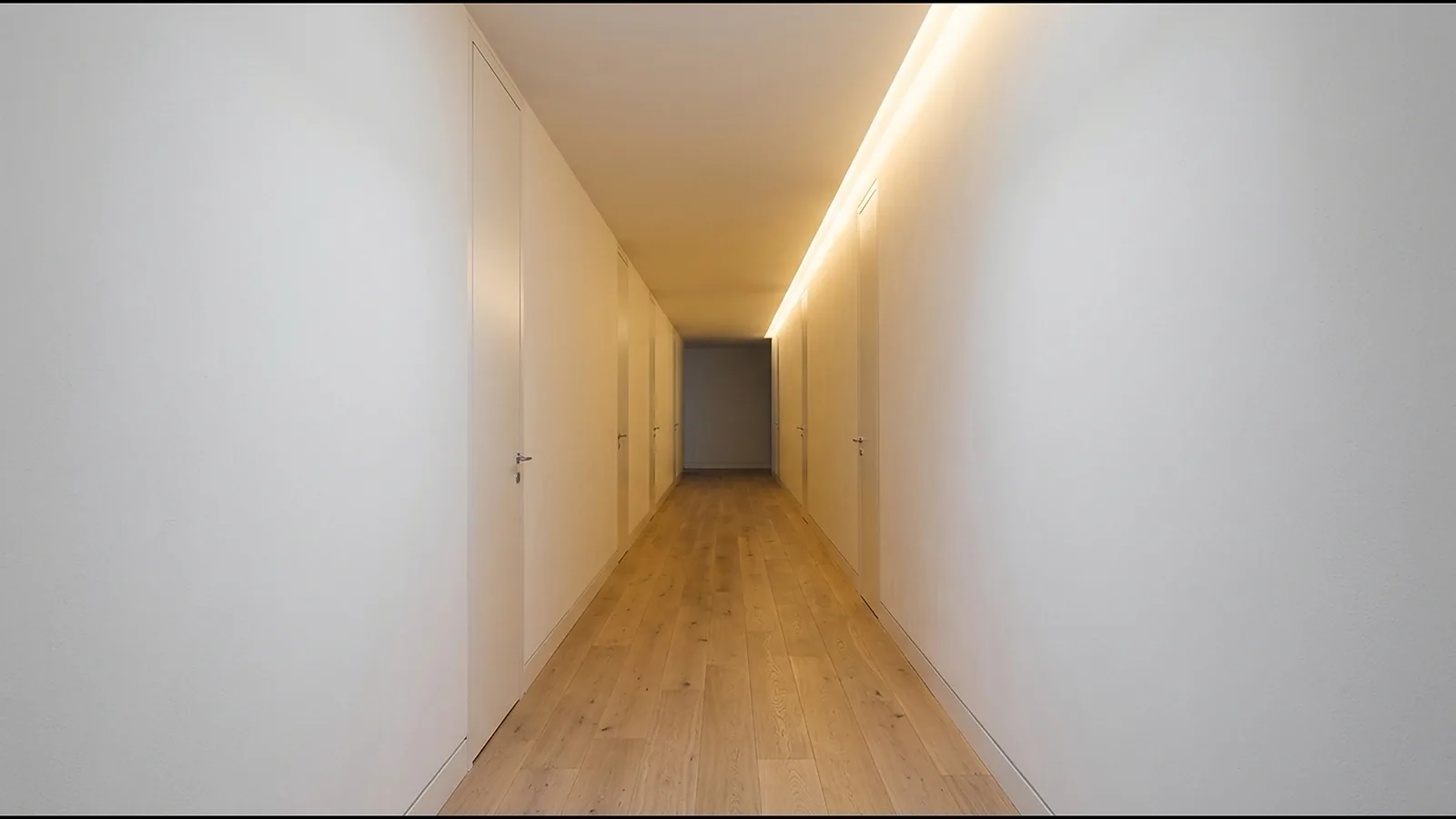
At the start of the line the strip shines at full brightness; at the end it is noticeably darker or has a different shade. This is caused by voltage drop, and it can be prevented.
Short answer: feed a 12 V strip from one end for no more than about 5 m; feed longer runs from both ends or split them into sections and connect each with its own feed. Keep the feeds from the power supply as short and as thick as possible. Where the run is long, choose a 24 V strip.
Why the end of the strip is dimmer
The copper tracks on the strip and the wires from the power supply have electrical resistance. When current flows through them, part of the voltage is “lost” along the way and less of it reaches the more distant diodes. The result is a drop in brightness towards the end of the run, and with CCT and RGB strips also a shift in shade, because the individual colours react differently to lower voltage.
The drop increases with current and length. For the same power, a 12 V strip carries twice the current of a 24 V one, so the problem is more pronounced. The more powerful the strip (more W/m), the sooner the drop shows.
How to tell
- The start and end of the run have visibly different brightness; the difference is most visible at full power.
- The white at the end of the strip looks different from the start (with CCT and RGB strips).
- The start of the strip or the feed wire is noticeably warm.
- When dimmed to low brightness the difference disappears; at full brightness it comes back.
Four ways to prevent it
1. Feeding from both ends
You bring the feed from the power supply to both the start and the end of the run (plus to plus, minus to minus). The current is split and the largest drop is in the middle, where it is much smaller than at the end of a run fed from one side.
2. Feeding from the middle
You connect the feed to the middle of the run and the strip runs out in both directions. The effect is the same as feeding from both ends, and one feed is enough.
3. Parallel feeds (star wiring)
Split a long run into sections of about 5 m and connect each section with its own feed cable directly to the power supply terminals. Do not connect sections in series in one long row, because the first metres of strip would then carry the current for the whole run.
4. 24 V strip
For the same power, half the current flows and the drop is much smaller. The e-shop has 13.5 W/m strips in the version 24 V and 12 V. For a 24 V strip you need a power supply with a 24 V output.
Cross-section of the feed wires
The drop does not occur only on the strip, but also on the cable between the power supply and the strip. The table shows an example: 5 m of 12.8 W/m strip (64 W) and a feed 3 m long.
| Wire cross-section | Drop at 12 V (5.3 A) | Drop at 24 V (2.7 A) |
|---|---|---|
| 0.5 mm² | 1.14 V (9.5%) | 0.57 V (2.4%) |
| 0.75 mm² | 0.76 V (6.3%) | 0.38 V (1.6%) |
| 1.5 mm² | 0.38 V (3.2%) | 0.19 V (0.8%) |
| 2.5 mm² | 0.23 V (1.9%) | 0.11 V (0.5%) |
So at 12 V a thin two-core 0.5 mm² cable takes away almost a tenth of the voltage before it even reaches the strip. A 1.5 mm² wire keeps the drop at around 3%; at 24 V a thinner one is enough. You will find the calculation in the box for professionals.
A practical example: a 10 m light line in a suspended ceiling
9.6 W/m strip, 96 W in total. At 12 V from one end, the end of the run would be visibly dimmer. Solution:
- Place the power supply in the middle of the run (in a suspended ceiling with an access opening).
- From its terminals you run two short 1.5 mm² feeds, each to one five-metre section.
- To be safe, you can also bring the far ends of both sections back to the power supply, or choose a 24 V strip with a 24 V power supply (we supply 24 V power supplies to order; call +420 777 500 070).
Power supply according to the calculation in the article How to choose a power supply: 96 × 1.2 = 115 W, i.e. RS-150 W, or two smaller power supplies, one for each section.
How to plan the power feed in advance
- Calculate the length of each run and its power (length × W/m).
- Decide where the power supply will be. Ideally in the middle or as close to the run as possible, always accessible.
- Split runs longer than roughly 5 m at 12 V into sections and plan a separate feed for each.
- Choose the wire cross-section according to the current and the feed length (table above).
- Lay the feeds before the suspended ceiling is closed or before the furniture is installed, and label their ends.
If you are not sure, call us on +420 777 500 070. We will help you split the run and choose the power supply.
Summary
Short runs up to 5 m at 12 V need no special treatment. For longer ones, the power plan is what matters: where the power supply will be, how the feeds will run and how thick they will be. Think it through before installation; adding a feed to a finished suspended ceiling afterwards is difficult. Extra cable costs little, tearing open a suspended ceiling costs a lot, so it is worth laying a feed even where you are not sure you will need it.
For professionals
Technical information for electricians, installers, joiners and architects.
Drop on the feed cable
ΔU = 2 · L · I · ρ / S, where L is the single length of the feed in m, I the current in A, S the cross-section in mm² and ρ the resistivity of copper 0,0178 Ω·mm²/m. The factor 2 covers the wire there and back. Example: L = 3 m, I = 5.33 A, S = 1.5 mm²: ΔU = 2 · 3 · 5.33 · 0,0178 / 1.5 = 0.38 V, i.e. 3.2% of 12 V.
Drop on the strip
A strip is an evenly distributed load. When fed from one end, the largest drop is at the end and equals I · R / 2, where I is the total current of the strip and R the loop resistance of the copper tracks over the whole length. When fed from both ends (or from the middle), the largest drop is in the middle and falls to I · R / 8, i.e. to a quarter. The value of R depends on the copper thickness of the strip and manufacturers do not usually state it, so their recommended maximum length for feeding from one end is used instead (for 12 V strips typically 5 m).
Current load on the strip tracks
The copper tracks at the start of the strip carry the current for the whole length that follows. Connecting reels in series beyond the recommended length therefore leads not only to a drop in brightness, but also to overheating at the start of the strip. A five-metre reel of 13.5 W/m at 12 V draws 5.6 A; two reels in series would carry over 11 A at the start.
Recommended values and measurement
- Keep the drop on the feed cable to about 3% of the rated voltage.
- Check by measuring: use a multimeter to measure the voltage at the start and end of the run at full brightness.
- Receivers and dimmers in the circuit have their own terminal contact resistance; tighten firmly and do not use unnecessarily long jumpers.
Frequently asked questions
How long an LED strip can I feed from one end?
For a 12 V strip about 5 m, for 24 V roughly twice that. Feed longer runs from both ends or from the middle, or split them into sections with their own feeds.
Can I connect two reels of strip in series?
At 12 V we do not recommend it. Connect each reel to the power supply with its own feed, otherwise the end will dim and the start of the strip will overheat.
What wire should I use from the power supply to the strip?
It depends on the current and the length. At 12 V with a feed of about 3 m to a five-metre run, use at least 1.5 mm²; a thin 0.5 mm² cable will lose almost 10% of the voltage.
Will a more powerful power supply help?
Ne. Voltage drop occurs in the wires and the strip, not in the power supply. A shorter, thicker feed, feeding from several points or a 24 V strip will help.
Build lighting made to measure
The guide puts together the profile, strip, power supply and control from e-shop products. We can also advise by phone +420 777 500 070.
Related articles
 Power supplies
How to choose a power supply for an LED strip
The power supply is the heart of the whole installation. If it is too weak, it overheats and the strip flickers. And anyone can work it out in a minute.7 min read Strips
How to choose an LED strip: chips, LED density and output
Choosing the right LED strip is key to efficient and reliable lighting. What matters is chip density, LED type, output and IP rating.7 min read Mounting
